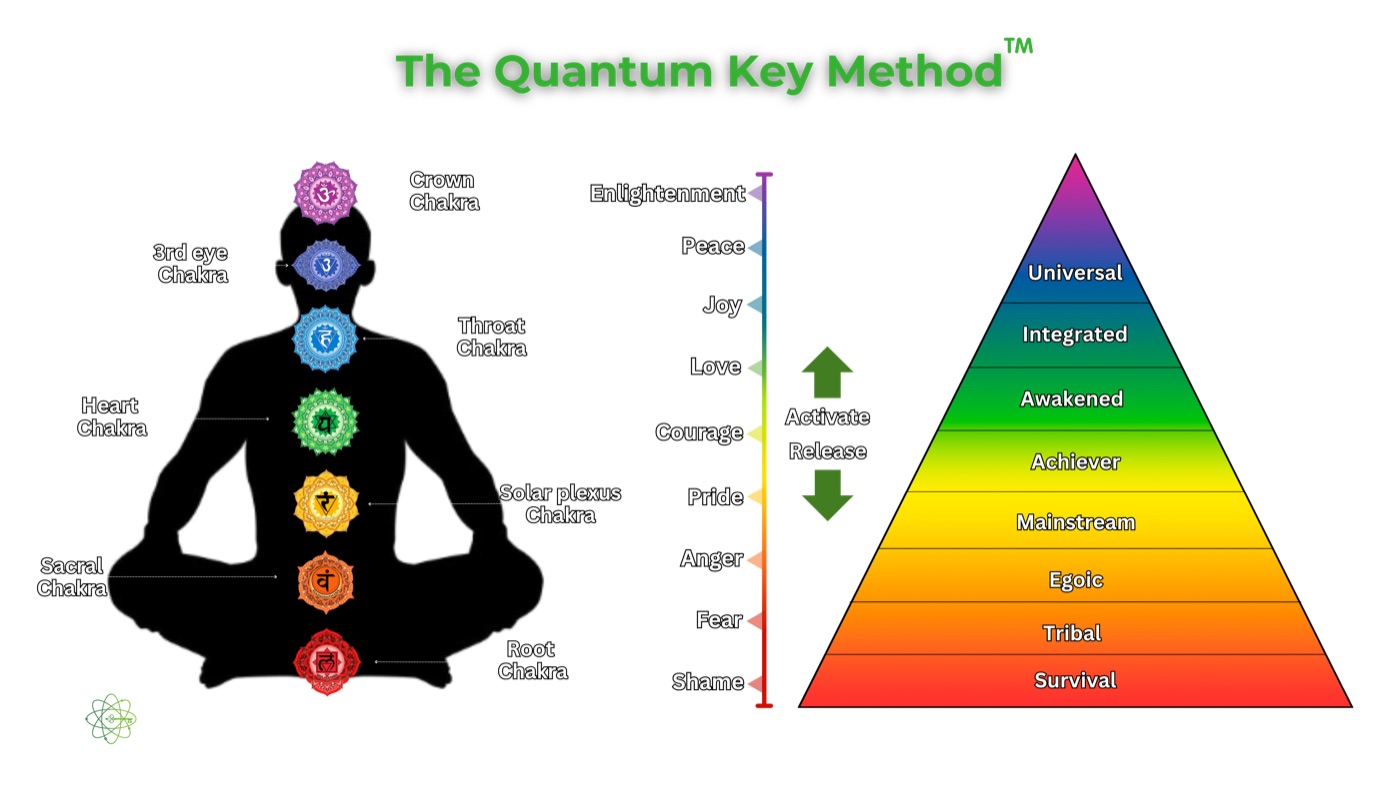
One of the most common questions about Quantum Key Institute is why the program covers six different modalities instead of going deep on one. The assumption built into the question is that depth and breadth are opposed. That a practitioner trained in six things must necessarily be shallower than a practitioner trained in one. It sounds reasonable. It also misses what actually happens in a client session.
The client doesn't show up sorted by modality
This is the part that's easy to forget until you've sat with a few hundred clients. People don't walk into a session with a problem that fits cleanly inside one modality. They walk in with a tangled situation that has cognitive layers, somatic layers, subconscious layers, energetic layers, and identity-level layers all woven together.
A single-modality practitioner can address one of those layers. The other layers either get ignored or get crudely translated into the modality the practitioner knows. So the client who needs nervous system regulation gets cognitive reframing. The client who needs identity work gets a breathwork session. The client who needs subconscious access gets handed a journal prompt.
The intervention sometimes helps. Often it half-helps and the client comes back next month with the same pattern dressed differently. Or they don't come back at all, because nothing actually shifted.
What an integrated practitioner can do
A practitioner trained across all six QKI modalities — Life Coaching, Hypnotherapy, Breathwork Facilitation, Meditation Teaching, Energy Healing, and the Quantum Key Method — can read what level the client's actual pattern is held at, and choose the intervention that meets it there. In a single session.
Cognitive pattern? Talk-based coaching frameworks. Subconscious pattern? Hypnotherapy. Somatic pattern stored in the body? Breathwork or somatic intelligence work. Energetic disturbance? Energy work. Pattern that needs witnessing more than intervention? Held silence and meditation-based presence.
The skill isn't running all six on every client. The skill is reading which one (or which combination) the moment is actually calling for.
The integration is the differentiator
Here's the thing single-modality schools often miss: the value of an integrated training isn't just having access to multiple tools. It's understanding how the tools relate to each other. Knowing when breathwork prepares the ground for hypnotherapy. Knowing when somatic release has to come before cognitive reframing. Knowing why a client who needs energy work won't be able to receive it until they've moved through some life coaching first.
That kind of practitioner judgment doesn't come from learning six separate things at six different schools and trying to stitch them together. It comes from learning all six inside one framework, with the integrating logic baked into the training.
That framework, at Quantum Key Institute, is the Quantum Key Method. Read more about the method itself.
The 12 Foundations underneath
The six certifications sit on top of a deeper layer the program calls the 12 Foundations. The Foundations cover the supporting frameworks that make the modality work hold together: the science (neuroscience, quantum physics, the subconscious mind), the philosophy (levels of consciousness, universal laws), the body (somatic intelligence, energy centres), and the practitioner craft (life coaching foundations, working with clients).
This is what makes a QKI graduate different from a graduate of six separate single-modality schools. The depth of integration. The shared underlying logic. The ability to draw on any of it in any moment, because all of it is connected.
One complete path
Time matters too. A practitioner who builds the full six-modality stack one school at a time will spend years getting there, with no guarantee that the modalities will fit together when they're finished.
The integrated path at QKI delivers all six certifications under one program, with the integration trained in from day one. Every modality is taught properly, to the same standard, inside one complete system. And the Business Incubator runs alongside, so the practitioner can actually run a practice on the other side.
For the full structure of the four QKI programs, see the programs page.
What this means for the kind of practitioner you become
The deeper answer to "why six modalities" is that the kind of practitioner the modern client needs is different from the kind of practitioner the old single-modality model produced. Clients have access to more information than ever. They've often tried one or two modalities already. By the time they get serious about working with someone, they're looking for a practitioner who can meet the complexity of their actual situation — not someone with one hammer.
QKI graduates can meet that. That's the whole point.