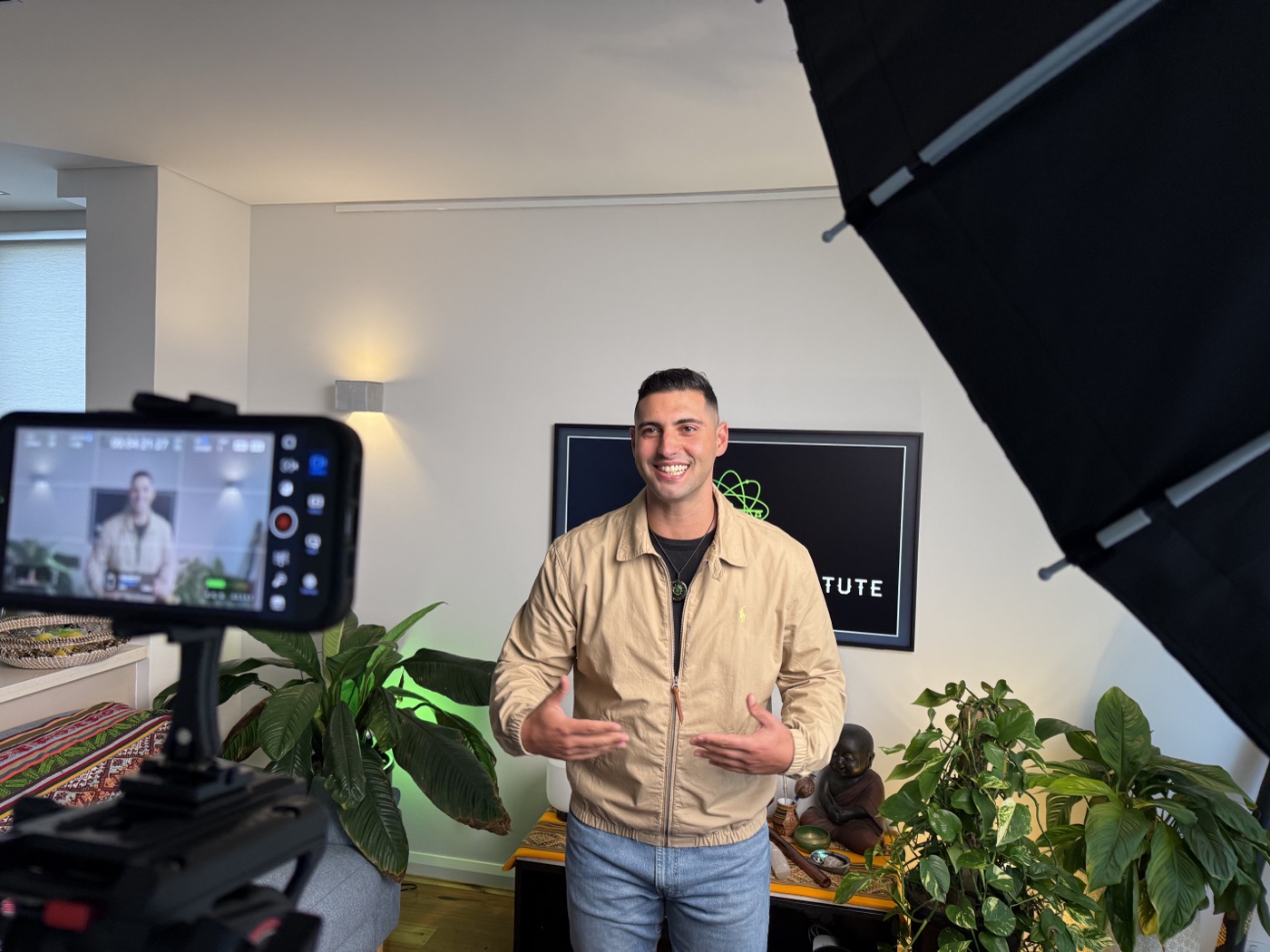
If you've ever sat across from another person in a coaching session, a hypnotherapy room, a breathwork chair — or any of the spaces where one human pays attention to another's life — you'll have noticed a particular thing. People walk in with surface problems. They describe the symptom. Money. Relationship. Confidence. Career. The story sits at the top.
If you stay in the conversation long enough, the surface problem stops being the problem.
Underneath almost every story is the same belief. Some version of: I'm not enough. Not good enough. Not smart enough. Not lovable enough. Not capable enough. Not worthy enough. Fill in the blank. The shape changes from person to person. The structure doesn't.
Seven thousand conversations later
I've spent the last decade or so in this work. Before Quantum Key Institute existed in its current form, I was running an online practice, then working with coaches on the business side, then mentoring practitioners and coaches one to one. The conversations stacked up. By the time I sat down to count, I'd had over seven thousand one-to-one calls and sessions.
That number does something to your pattern recognition. After a while you stop hearing the surface story as a unique thing. You start hearing the shape of it.
And the shape is almost always the same.
Long before I'd had thousands of those conversations with other people, I'd had thousands of them with myself.
This is the thing that takes a while to land. The story you're telling yourself feels singular. The grief, the wound, the betrayal, the rejection, the specific shape of why-it-happened-to-you. It feels like nobody else has lived inside that exact configuration. And in a literal sense, that's true.
But the underlying structure — the "I'm not enough" engine that's running the show — is one of the most common patterns in human psychology. Thousands of people have lived the same shape. Thousands have come through it. Many have built lives on the other side that are unrecognisable from where they started.
This is one of the most important pieces of the work at Quantum Key Institute. Not just teaching practitioners to recognise the pattern. Teaching them to hold it without flinching when a client brings it into the room.
The architecture of the "not enough" belief
A belief like this doesn't come from nowhere. It gets built, piece by piece, often before we have language for what's happening. A look across a dinner table at age six. A teacher's comment that lands differently than they intended. A parent who couldn't say the words. A moment that gets coded as evidence and stored as a rule about reality.
By the time a person is forty, the rule has been reinforced ten thousand times by their own mind. Because here's the trick: humans are meaning-making machines. We're masters of meaning. Once a belief is installed, the mind goes looking for evidence to confirm it. It finds the evidence everywhere, because reality is ambiguous enough that you can read almost anything as proof of anything.
The person who believes they're not lovable enough will read a partner's tiredness as confirmation. The person who believes they're not smart enough will read a colleague's promotion as confirmation. The person who believes they're not worthy of money will manufacture obstacles between themselves and the money, then point at the obstacles as proof.
The belief becomes self-fulfilling. Then the person decides the self-fulfilling outcome is evidence the belief is true. Then the belief reinforces. The loop closes.
What the modalities miss when they only work at the top
This is the part I want practitioners to really sit with.
Most coaching, most mindset work, most "manifestation" content operates at the level of behaviour. Change the routine. Change the affirmation. Change the goal. Do the work. Take the action.
None of that is wrong. Some of it is necessary. But if the "not enough" engine is still running underneath, the behaviour change doesn't last. The person hits a ceiling. The ceiling is the belief they haven't dealt with yet. The new behaviours bump up against it and the old identity quietly pulls them back to where they started.
This is why people repeat the same dynamics across different jobs, different relationships, different cities. The external circumstances change. The internal pattern doesn't. So the same shape of life keeps re-forming, just with different actors.
The work that actually shifts things has to go to the level the belief lives at. That's identity. Not behaviour. Not strategy. Not goal. Identity — the answer to "who am I" underneath the surface story.
What you do about it as a practitioner
Three things have helped me in the room with clients who are sitting on this pattern. None of them are clever. All of them work.
One. Don't try to talk the client out of the belief. The belief feels true. Arguing with it directly almost never moves it. Instead, get curious about it. Ask where it came from. Ask what it costs. Ask what it pays for. Beliefs persist because they're useful at some level — usually protecting against something. Find the function.
Two. Work at the level the belief is stored. Cognitive beliefs respond to cognitive work. Beliefs stored in the body (most "I'm not safe enough" beliefs are body-stored) need somatic work. Beliefs that sit at the subconscious level need hypnotherapy or deep meditation states. The Quantum Key Method is built around reading where the belief is held and meeting it there — rather than throwing every tool at the surface.
Three. Give them the data that they are not alone in this. Not in a "everyone feels this way" dismissive sense. In a "thousands of people have lived exactly this and come through" sense. Sometimes the most healing thing a client hears is that the pattern they're embarrassed by is one of the most common patterns on the planet, and people have built remarkable lives starting from inside it.
What this changes about the work
Once you can see the "not enough" pattern at the bottom of most client stories, your job as a practitioner changes shape. You stop trying to fix the symptom. You stop running the same playbook on every client. You start listening for which version of "not enough" is at the bottom of this specific person's work, and what level it's stored at, and what tool actually reaches that level.
This is what an integrated practitioner does that a single-modality coach can't.
It's also why the answer is rarely a single modality. Talk coaching can sometimes get the cognitive layer. Breathwork can move the somatic layer. Hypnotherapy can reach the subconscious layer. Energy work can shift the layer underneath that. Meditation can hold the integration. The practitioner who can move between them, reading what level the client is actually held at — that's the practitioner whose clients break the pattern instead of just rearranging it.
That's what we train at QKI.
Luke Stringa is the CEO and co-founder of Quantum Key Institute. His background spans mechanical engineering, IT, coaching and hypnotherapy, and the business side of the coaching industry before building QKI. Read more about Luke.